Sheet D-120 · London, Ontario
Stamped Concrete in London, Ontario
The look of slate, stone or brick, poured as one solid slab and built for freeze and thaw.
Everything worth knowing before you pick stamped concrete for a driveway, patio, pool deck or walkway: patterns, how the colour is done, what happens on pour day, how it handles salt and ice in a London winter, and how to keep it looking new.
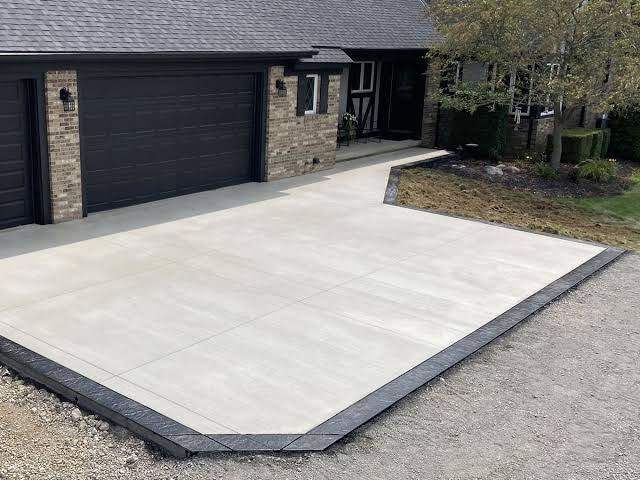
Under the pattern
Same base and mix as a plain driveway. The pattern is only as good as what it sits on.
Concrete
32 MPa, air entrained for freeze and thaw
Base
Compacted Granular A, graded to drain
Upkeep
Reseal about every 2 to 3 years
Spec 01 · Where it works
Stamped is a finish, not a different slab.
Any concrete we pour can be stamped. The dig, the base, the mix and the reinforcement are the same as a plain broom slab; the pattern and colour go on top in the hours after the pour. That is why a cheap stamped job and a good one can look the same on day one and very different after three winters.
S-1
Driveways
A full stamped driveway, or a broom field with a stamped border and apron. Same base and mix as any driveway we pour.
S-2
Patios
The most popular place for it: a backyard slab that reads as flagstone or slate, with steps and a seat wall edge to match.
S-3
Pool decks
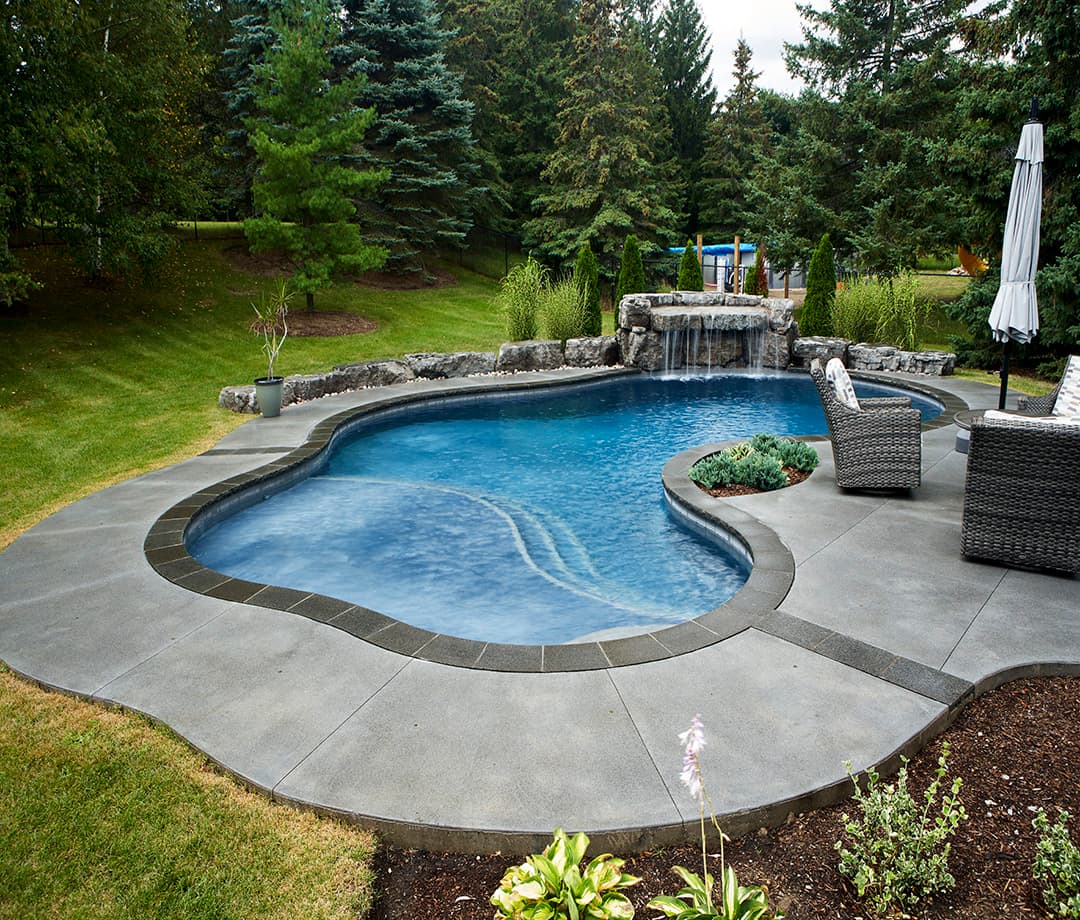
Textured patterns with grit in the sealer for wet feet, and a lighter colour that stays cooler in July.
S-4
Walkways, steps + porches
The path from the driveway to the door, where a pattern does the most for curb appeal per square foot.
On a budget? A stamped border around a broom-finish driveway or patio gets most of the curb appeal for a fraction of a fully stamped slab. See the finish options on our concrete driveways page.
Spec 02 · Patterns
Five pattern families, and where each one fits.
Deep grout lines look the most like real stone but hold snow and catch a shovel blade, so on a driveway we lean toward slate or seamless textures, and save cobble and brick for borders and walks. You see real samples at the site visit before anything is ordered.
Ashlar slate
Squares and rectangles of cut slate in a running layout. A clean, classic layout that suits a modern or a traditional house.
Best forDriveways, patios, porches
Random flagstone
Irregular stone shapes with natural looking grout lines. Softer and more relaxed, made for backyards.
Best forPatios, pool decks
Brick or cobble
Running bond, herringbone or old world cobble. Strong as a border band or a walkway, busy across a whole driveway.
Best forBorders, aprons, walkways
Wood plank
Boards with grain and nail holes, in grey or brown tones. The look of a wood deck with nothing to rot or splinter.
Best forPatios, pool decks
Seamless texture
Stone texture with no grout lines at all. The easiest stamped surface to shovel and keep clean, and the most forgiving to walk on.
Best forDriveways, steps, high-traffic areas
Spec 03 · Colour
Two colours make it look like stone.
A base colour for the "stone" and a darker release colour for the joints and texture. One colour alone reads flat.
Choosing for London: mid greys and earth tones hide salt residue, tire marks and road grime best. Very dark colours get hot in summer sun, which matters on a pool deck. Bright whites and pastels show every stain.
Match the house, not the brochure: pick the colours outside, next to your brick or siding, in daylight.
Integral colour
Pigment is mixed into the concrete at the plant, so the colour runs all the way through. A chip or scrape shows the same colour, not grey. Usually the softer, more natural look.
Colour hardener
A dry-shake colour broadcast onto the fresh surface and floated in. Brighter, richer colour, and a denser, harder-wearing top, which matters on a driveway that sees salt and tires.
Release (accent) colour
A powder that keeps the stamp mats from sticking. It stays in the low spots and grout lines and gives the second tone that makes stamped concrete look like real stone instead of coloured concrete.
Spec 04 · How it is built
From the dig to the sealer.
Stamping is a race against the concrete. Once it starts to set there is a short window to colour, release and press the pattern, so pour day is planned around the weather and the size of the slab, and we pour when it is above 5 °C.
-
Before pour day
Dig out and build the base
Old surface removed, soft soil dug out, then compacted Granular A in lifts, graded so water runs away from the house. Forms set to the final height and slope. This is the part you never see and the part that decides whether the pattern stays flat.
-
Pour
Place, screed and float
32 MPa air-entrained concrete for freeze and thaw, reinforcement held up in the slab, struck off and floated flat. Integral colour is already in the truck; colour hardener goes on now and is floated in.
-
Pour, an hour or two later
Release and stamp
Release goes on, then the mats are laid and pressed in sequence while the concrete is at the right stiffness. The window is short, so the crew is sized to the slab and the pour is timed to the weather.
-
Same day
Detail the edges and seams
Edges, steps and the spots the mats cannot reach are textured by hand, and mat seams are blended so the pattern runs without a break.
-
Next day
Cut the control joints
Joints are saw-cut along grout lines of the pattern where we can, so they disappear into the design instead of slicing through a stone.
-
A few days on
Wash off the release
Extra release powder is washed away, leaving the accent colour in the grout lines and texture.
-
Once cured
Seal
Two thin coats of decorative sealer, with slip-resistant grit added where people walk wet or in winter. Sealing deepens the colour and keeps salt and water out of the surface.
Spec 05 · A London winter
Freeze, thaw, salt and ice.
London sees dozens of freeze and thaw swings every winter, plus salt from the street and the shovel. The surface flaking off in thin pieces, called scaling, is the most common way decorative concrete fails here. It is prevented at the plant and on pour day, then kept away with sealer.
The mix
Air entrained, 32 MPa
Billions of tiny air bubbles give freezing water room to expand. It is the CSA exposure class for outdoor slabs that see freeze and thaw plus de-icing salt.
Year one
No salt the first winter
Young concrete is the most easily damaged. Use sand for grip, and watch the salty slush your car drags in from the road.
After that
Little salt, never ammonium
Plain rock salt, as little as works, shovelled off once it does its job. Never de-icers or fertilizers with ammonium nitrate or ammonium sulfate.
Shovels + blowers
Plastic edge, raised skids
A plastic shovel blade and snow blower skids set a little high keep the sealer and the pattern's high points from getting scraped bare.
Slip: sealer makes any concrete smoother. On walks, steps and pool decks we add slip-resistant grit to the sealer and steer you to a textured pattern, so the surface grips in the rain and under light snow.
Spec 06 · Stamped vs broom vs exposed
Is stamped the right finish for you?
We pour all three on the same base, so the honest answer depends on what you want from the surface. Stamped wins on looks. Broom wins on cost and grip. Exposed aggregate sits in between and hides wear best.
Broom finish
- Looks like
- Plain concrete with fine grooves
- Grip
- Very good, wet or snowy
- Upkeep
- Lowest. Sealing optional but helps against salt
- Cost
- Lowest
Exposed aggregate
- Looks like
- The stone inside the mix, washed out to show
- Grip
- Very good
- Upkeep
- Low. Reseal every few years
- Cost
- Middle
Stamped
- Looks like
- Slate, stone, brick or wood, in colour
- Grip
- Good with a textured pattern and grit in the sealer
- Upkeep
- Most. Reseal every 2 to 3 years
- Cost
- Highest of the three
Pick stamped if the slab is a feature people see every day, like a front walk, a porch or a backyard patio. If you mostly want a durable place to park, a broom driveway with a stamped border is the smart middle ground.
Spec 07 · Sealing and resealing
The sealer is the upkeep. Keep it fresh.
A decorative acrylic sealer brings out the colour and keeps water and salt on top of the surface instead of inside it. It wears off with sun, tires and shovels, so it gets renewed.
- When: about every 2 to 3 years, or as soon as water stops beading and starts soaking in.
- Weather: a dry stretch, mild temperatures, no rain for a day after. Late spring and early fall are ideal in London.
- How: wash it clean, let it dry fully, then two thin coats. Thick coats peel and turn cloudy.
- Grip: add slip grit to the last coat on anything people walk on wet.
- White haze? That is moisture under the sealer, usually from sealing too soon after rain. It is fixable; do not pile more sealer on top.
Around a pool, the same rules apply with more water and chlorine: see concrete pool decks in London.
Spec 08 · Comparing quotes
Nine things every stamped quote should say.
Stamped quotes in London can differ a lot, and the gap is usually under the pattern: less base, a weaker mix, one coat of sealer. Line them up against this list. Our written quote answers every line.
Permits, briefly
A stamped driveway follows the same City of London width limits as a plain one, and widening or a new curb cut needs City approval. Backyard patios usually need no building permit, but the water still has to drain away from your house and your neighbour's. We check your lot at the visit; the City has the final word.
- The pattern and both colours (base and release) in writing, picked from real samples.
- Colour method: integral, colour hardener, or both.
- Base: depth of compacted Granular A, and what happens if soft soil turns up.
- Concrete: strength in MPa and air-entrained for freeze and thaw.
- Thickness and reinforcement, especially on a driveway.
- Sealer: type, number of coats, and whether slip grit is included.
- Where the control joints go, and whether they follow the pattern.
- Tear-out and disposal of the old surface included, or extra.
- What the first reseal costs and who does it.
Spec 09 · Stamped concrete questions
Asked before every stamped quote.
How long does stamped concrete last in London, Ontario?
Built on a proper compacted base with 32 MPa air-entrained concrete and kept sealed, stamped concrete lasts decades here. What fails early is almost always the build (thin base, the wrong mix, no air entrainment) or a sealer that was never renewed, which lets salt and water into the surface.
Is stamped concrete slippery in winter?
Sealed concrete can get slick when wet, the same as a polished stone. We cut that down three ways: textured patterns instead of smooth ones where people walk, slip-resistant grit mixed into the sealer, and a broom or seamless texture on steps. Clear snow early and use sand when it is icy.
Can I use salt on stamped concrete?
Skip salt in the first winter while the concrete is young; use sand for grip. After that, use as little rock salt as you need, shovel off the slush, and keep the sealer fresh so the salt stays on top. Never use de-icers or fertilizers containing ammonium nitrate or ammonium sulfate; they attack concrete.
How often does stamped concrete need resealing?
About every 2 to 3 years, sooner on a driveway in full sun or one that is salted a lot. The test is simple: if water stops beading on the surface and soaks in, it is time. Resealing is a clean, dry day of work and keeps the colour from fading.
Will stamped concrete crack?
All concrete can crack; the goal is to control where. A compacted base, reinforcement and control joints placed on the pattern's grout lines keep cracks in the joints, where they hide in the design.
Can you stamp my existing concrete?
No. Stamping is done in fresh concrete in the hour or two after it is poured. Thin stamped overlays exist, but they only last if the slab under them is sound and flat; if the old concrete is heaved or cracked through, replacing it is the fix that lasts. We tell you which one your slab needs at the site visit.
When can I walk and drive on new stamped concrete?
Usually light foot traffic after a day or two and cars after about a week, with heavy trucks kept off for about a month. Cool fall weather slows curing, so we give you the exact dates for your pour.
Is stamped concrete better than interlock?
They suit different people. Stamped concrete is one solid slab, so there are no joints for weeds or ants and no single pieces settling or heaving over time; it needs resealing every few years. We pour concrete only, so we will tell you plainly whether stamped, exposed aggregate or broom fits your yard and budget best.
Do I need a permit for a stamped concrete driveway or patio in London?
The finish does not change the rules: a stamped driveway follows the same City of London driveway width limits as any other, and widening it or adding a new curb cut needs City approval. Backyard patios usually do not need a building permit, but grading and drainage onto a neighbour still matter. We check what applies to your lot at the site visit; the City has the final word.
Free site visit
We measure, bring pattern and colour samples, and leave you one written quote.
More from the same crew: concrete driveways in London, pool decks and pool work. Outside London? We also pour in St. Thomas.